
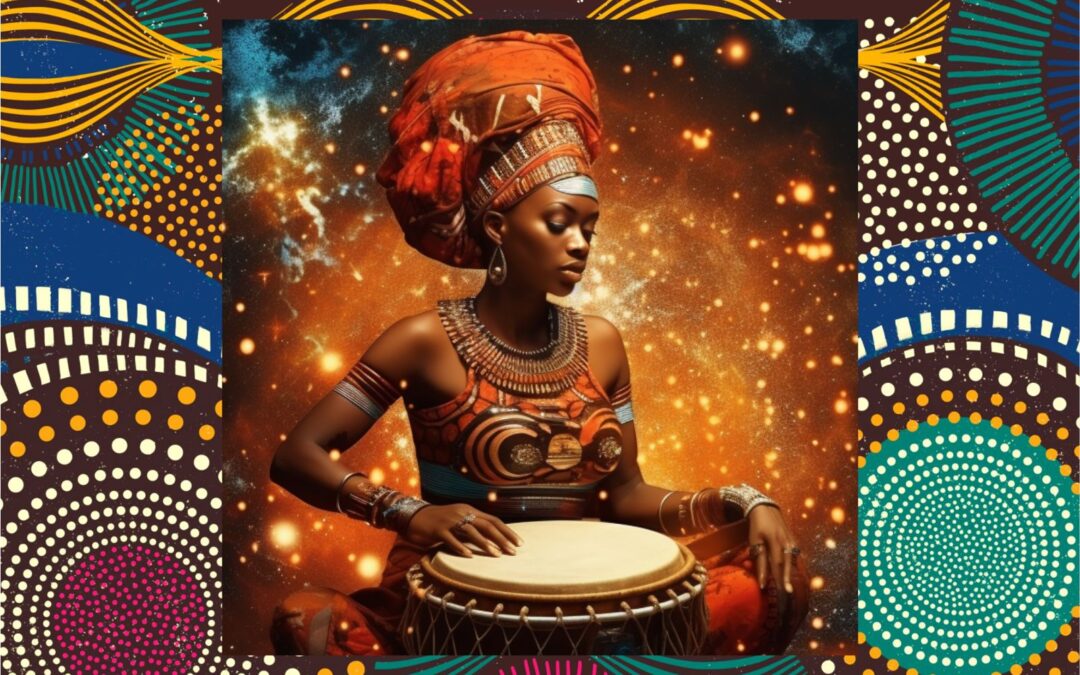
This Women’s Month, we’re putting the spotlight on a side of drumming history that we love to celebrate: the story of women and the drum.
At Drum Cafe Cape Town, every session we run is built on one simple truth: when everyone in the circle picks up a drum, everyone’s rhythm matters equally. No lead instrument, no hierarchy, just one collective beat. It turns out that idea has a much deeper, much more complicated history than you might expect.
Did you know the djembe was historically off-limits to women?
For generations in parts of West Africa, drumming, especially on sacred instruments like the djembe, was considered strictly male territory. Women were often kept from learning or even touching certain drums, with some traditions treating them as taboo for female hands entirely.
It took trailblazers to change that. Celebrated Senegalese master drummer DouDou N’Diaye Rose broke with convention and formed one of the first all-female drumming ensembles. Featuring his own daughters and grandaughters, the group was called Les Rosettes. In Guinea, the birthplace of the djembe, an all-female ensemble called Nimbaya now performs the very drum women were once barred from playing.
Did you know women were often the ones leading the celebration, just not the drum?
Here’s a nuance worth knowing: while women were frequently excluded from playing certain sacred drums, they weren’t absent from the ceremony itself. In many West African cultures, celebrations like weddings and naming ceremonies were led by Griots (or Djelis), often women, who sang praises, told stories, and directed the entire event. Far from being simple entertainers, Griots are highly respected keepers of history, oral historians and genealogists entrusted with preserving a community’s stories, lineage, and cultural memory across generations. These women even had their own name for the role: a griotte, or Jelimuso in the Mande languages of Mali, Guinea, and Senegal. The drum may have belonged to the men, but the story and rhythm often belonged to the women.
Did you know rhythm has long been a tool of resistance?
Long before it was a team-building tool, rhythm was a tool of resistance across Africa, used by communities of all genders to organise, communicate, and unite. Women have their own powerful chapter in this story too. In Nigeria’s 1929 Aba Women’s War, thousands of women staged a mass uprising against colonial taxation, using song, dance, and public ridicule chants to shame corrupt officials and force real policy change. It’s a reminder that rhythm, in all its forms, has always carried more than just a beat.
Did you know today’s female drummers are rewriting the rules?
The tide is turning, and fast. In Rwanda, a decade after the genocide, Ingoma Nshya, the country’s first all-female drumming group, was founded to bring Hutu and Tutsi women together, using rhythm as a path to reconciliation.
In Kenya, percussionist Kasiva Mutua learned to drum from her grandmother as a child, only to spend her teenage years being told a drum “wasn’t for girls.” She was publicly shamed for playing an instrument held between her legs, and once came home to find her djembe had been forcibly torn apart. She kept playing anyway. Today she performs on stages worldwide and founded MOTRA, an all-female group dedicated to keeping traditional drumming alive for the next generation.
Across the continent, women are picking up instruments that once excluded them and making them their own.
Why this matters in the circle
When your team sits down at a Drum Cafe session, they’re taking part in something with real history behind it: a tradition that has excluded, protested, celebrated, and is now being reclaimed, one beat at a time. It’s a good reminder of what we see in every session we run: the circle only works when everyone gets to contribute, and the most powerful rhythms are the ones built together.
This Women’s Month, we’re celebrating the women who broke the rhythm barrier, and the ones still doing it today.
Want to bring the power of the circle to your team? Get in touch with Drum Cafe Cape Town to book your session.